Protect the Details That Identify You Offline
A public profile rarely needs a home address, workplace, financial information, daily route or medical record. Start with a unique password, keep notification previews discreet and review each photo for location clues or another person’s private information.
The profile guide offers a useful way to write warmly without revealing too much.
Use Photo Controls as a Boundary, Not a Guarantee
Private albums and selective sharing can give you more control over who sees a photo, but they cannot eliminate screenshots or pressure. Share more only when someone has earned trust through consistent behavior. The private album guide explains this distinction.
Keep Early Conversation in a Space You Control
Stay in the service while you assess a match. Be cautious when someone pushes for money, personal contact details, intimate images or an immediate meeting. Before meeting, choose a public place, maintain independent transport and use the first-date checklist.
Know Which Control You Need
| Concern | Relevant Control | Important Limit |
|---|---|---|
| Selected photographs | Private Album permissions | Cannot undo a saved copy. |
| Being discovered | Profile visibility or hiding options | Existing interactions may remain. |
| Unwanted contact | Block and report | Do not rely on blocking alone for a threat. |
| Phone-screen exposure | Device locks and notification previews | Account privacy does not control the whole device. |
Verification Is Not a Background Check
PositiveSingles states that it does not conduct member background checks. Photo verification can help link a submitted face to a profile, but it does not verify employment, criminal history, intentions or health status. Do not treat a verified photograph as proof that a person is safe to meet privately. Consistent conversation and a practical meeting plan remain important. Our review separates useful trust signals from guarantees the product cannot make.
Album Permissions and Conversation Visibility
The album guide explains approving recipients and later removing access. Hidden conversations are another feature: the service documents hiding a chat and restoring it through Hidden Conversations in Settings. That is an organization or visibility choice inside your account, not deletion of the other person’s copy. Similarly, removing an app from a phone does not necessarily close an account or cancel billing. Know whether you want to reduce visibility, stop contact or end a subscription.
When to Stop Instead of Investigate
Do not send money, verification codes or documents to a match who says these are needed to prove affection or unlock an account. Use the legitimate support route for account matters. If somebody makes a threat, preserve the relevant information without circulating intimate material and use appropriate local emergency help when danger is immediate. You do not need to confront a person to establish that a boundary has been crossed.
Privacy Across the Whole Dating Journey
Your profile, phone and off-platform contact details are separate surfaces. A reused public photograph may connect a dating account with another profile elsewhere. A social-media connection may disclose friends and family even if the dating bio is careful. The digital privacy article explores those wider choices. Start with limited, accurate information; add more only when the connection and purpose justify it. Thoughtful control supports honest dating rather than requiring complete secrecy.
Decide What Each Privacy Tool Is Protecting
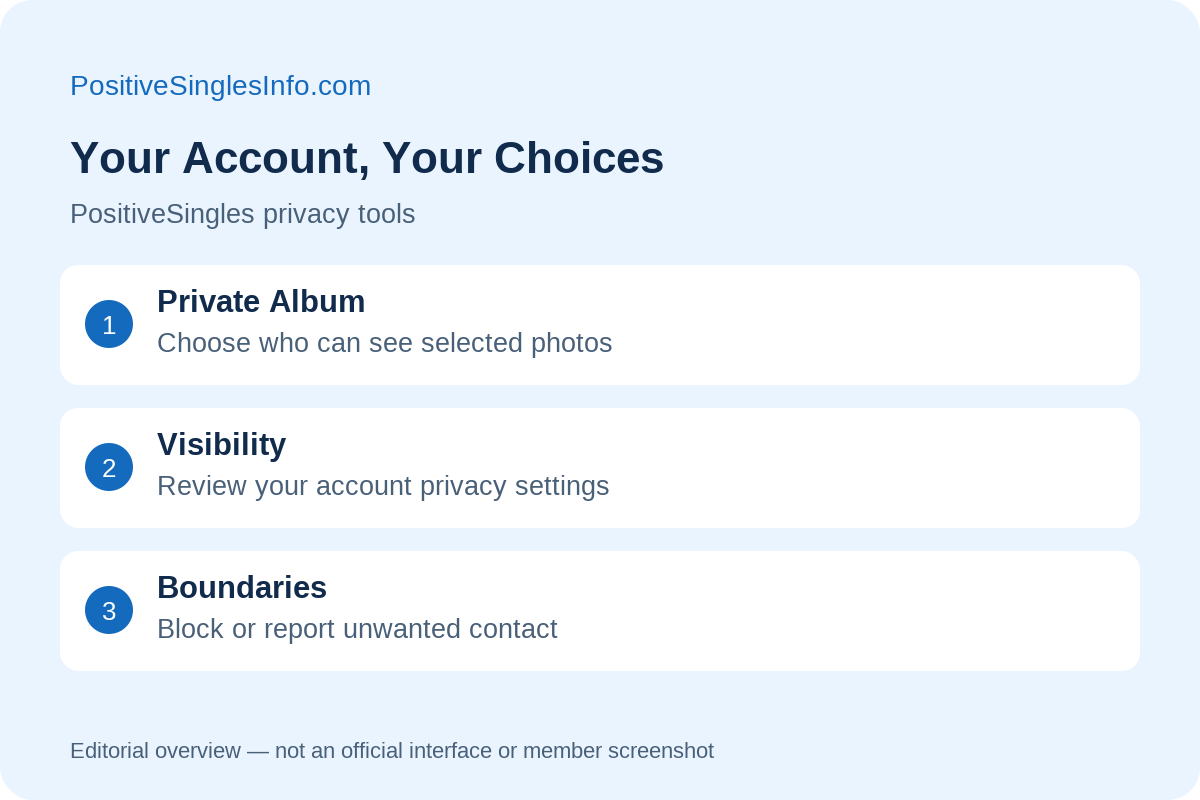
Privacy is not one switch. Photo access, profile visibility, unwanted contact and information shared in a conversation are different concerns. A tool can help with a specific exposure without solving all the others. Naming the concern makes it easier to choose the right action.
Photos You Share Selectively
A private album lets you make a separate decision about selected photographs. Before uploading, look for identifying details in the image as well as the person pictured: a work badge, a house number or a location you visit routinely. Restricting platform access does not remove those details from the photograph itself.
Grant access because you want to, not because a new contact says it is required to prove trust. Removing access later changes platform viewing, but cannot guarantee that information already seen was never saved elsewhere. The dedicated album guide explains the distinction between album access and overall profile visibility.
Information You Put into a Message
A conversation can reveal more than a profile. You may mention a workplace, a daily commute or a predictable time you are home alone without realizing those details form a pattern. Keep early exchanges personal enough to connect while leaving unnecessary identifying information out.
That does not mean every conversation must sound guarded. Discuss an interest or a broad neighborhood activity without sending an exact address or a live location to someone you barely know. You can be warm and specific about what you enjoy while being deliberate about what another person needs to know at this stage.
Verification and Trust Are Different
The service describes photo verification as helping confirm a likeness to submitted photographs. It does not establish somebody’s medical information, relationship intentions, occupation or criminal history. A badge should not end your questions about consistency, consent or realistic plans.
A voice or video conversation can make an introduction more human, but it also does not prove every claim. Build trust through how someone responds over time. Pressure for money, account codes or intimate material is not made acceptable by a photograph, a verification indicator or a convincing personal story.
Blocking, Reporting and Leaving
Blocking concerns unwanted contact; reporting asks the service to review conduct. Use the route that fits what happened, and preserve relevant information privately when a report may need it. You do not owe a long argument before ending an exchange that feels coercive or persistently unwelcome.
If the concern is immediate danger, use appropriate local emergency help rather than wait for a platform response. For an account or privacy-control question, support can explain the service action. PositiveSinglesInfo.com can clarify an article but cannot intervene in another member’s account.
Make Your Next Step Proportionate
You do not need to reveal everything because a conversation has become friendly. Nor does a privacy preference automatically mean another person is dishonest. Respect boundaries on both sides and judge behavior in context. The useful outcome is an introduction that can develop at a mutually comfortable pace, supported by tools whose actual limits you understand.