Ask Whether the Community Fits Your Real Goal
Before joining PositiveSingles, decide what you want the service to help with: meeting a long-term partner, dating more openly, finding conversation with people who understand an STI-related context, or simply seeing whether the local community feels relevant. A clear goal makes it easier to judge profiles and features without treating registration as a promise of a specific result.
Read the PositiveSingles review alongside the platform's public information, then make a profile only if the purpose feels useful to you.
What Can You Check Before You Pay?
Check the current membership options, renewal language, cancellation path and features at the time you are considering an upgrade. Public information and store listings change. It is reasonable to begin with available free access, test whether the people and tools are relevant, and then decide whether a paid option supports what you are actually doing.
The cost guide collects the questions worth asking about plans, and the free-membership page explains the difference between access and premium features.
How Will You Protect Your Privacy?
Decide which photos and personal details belong in a profile before you upload them. Review phone notifications, private-album choices and whether a family member can see your screen. Keep early conversations in the service until someone has shown consistent, respectful behavior.
If a member pushes for money, a private image, travel or an immediate move off-platform, pause. Read the privacy guide for a fuller account of practical boundaries.
Use the First Week as Research
Write a complete but protected profile, browse at a manageable distance, read several bios and send a few messages that refer to genuine details. The first week can tell you much more than marketing language can. If the experience feels relevant, join PositiveSingles and continue at your own pace.
What Does This Service Actually Let Me Try?
Free registration includes a profile and basic participation, while Premium adds broader communication and advanced tools. The membership comparison is useful because it separates actions instead of calling the whole experience either free or paid. The price guide retains actual public term totals so you can think about the commitment rather than a vague promise of value.
Choose a trial question you can answer from the service: do profiles in my reach describe compatible goals, can I express myself comfortably, and does the interface support the kind of conversation I want? Those observations are more useful than assuming a global member total predicts a local relationship.
What Does Verification Mean Here?
A photo check is not a medical or criminal-background check. PositiveSingles says medical records are not required or verified and states that it does not conduct member background checks. Read the review for the difference between trust signals and guarantees. If you would only feel comfortable on a medically verified matching service, do not assume a dating app provides that merely because its audience is condition-focused.
Do I Want the Website, the App or Both?
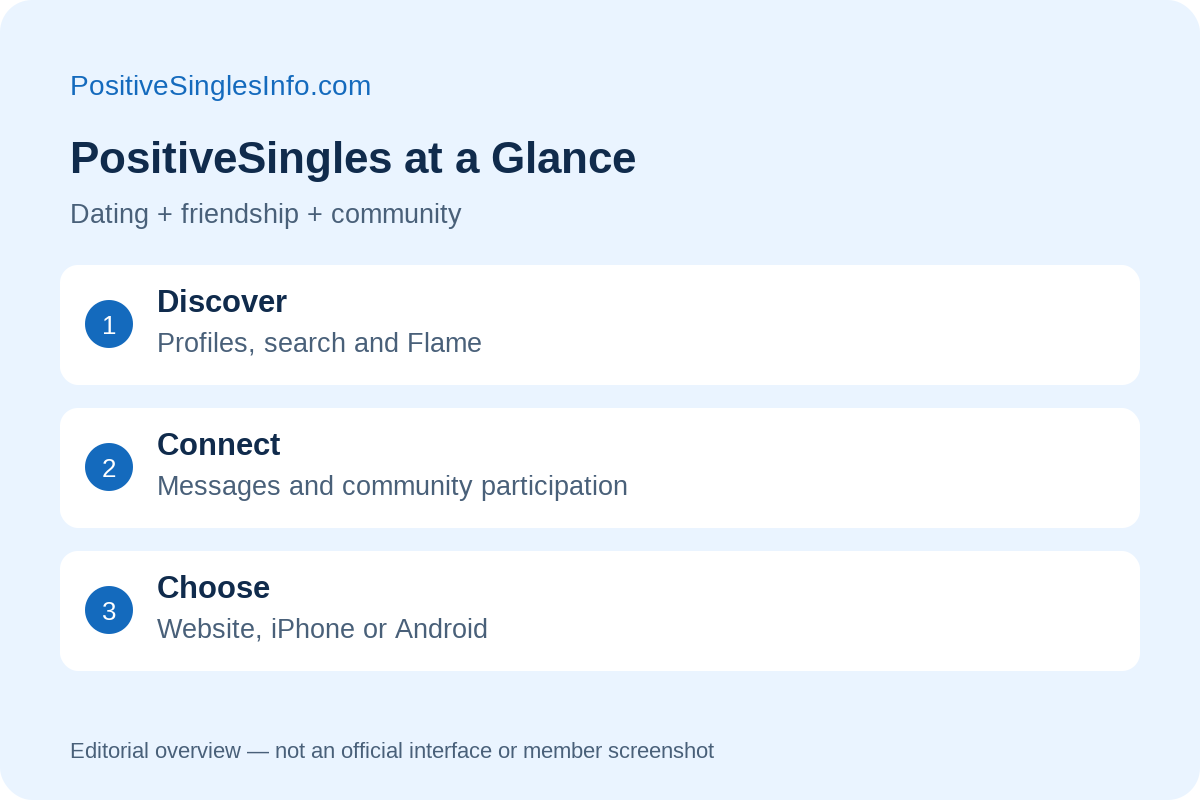
Choose by task. A computer can make drafting and plan comparison easier; a phone can keep a conversation moving. The screen comparison explains the choices. You do not need to create separate accounts simply to use different devices. Consider where a notification or shared screen might reveal more than you intend before making the app part of your daily routine.
What Would Make Joining Useful Even Without an Immediate Match?
You might gain a clearer sense of the community, write a more natural profile or have one respectful conversation. Those are not substitutes for a relationship if that is what you want, but they are real information for deciding whether to continue. If the service sounds relevant, registration guidance explains preparation and PS4A explains an optional published offer. Join because the setting answers a need, not because a code or headline creates urgency.
Test One Feature Against One Real Need
Choose a task before evaluating a feature. If you want to contact someone whose profile feels relevant, look at the message-access rules. If you prefer to share some photographs selectively, understand Private Album rather than assume all images are hidden. If distance is the concern, inspect actual profiles and the available location controls. A long feature list has little meaning until it is connected to something you plan to do.
You can write the question in plain language: “Can I respond to this conversation with my current membership?” or “Who can see this photograph?” Those questions are easier to verify than “Is this the best app?” They also stop an optional paid tool from being mistaken for a requirement to belong in the community.
What Would Make You Continue—or Decide Against It?
Decide what evidence would justify another month of participation. Relevant profiles, respectful exchanges and a routine you enjoy are useful signals. An unrealistic distance or a mismatch of relationship goals may be reasons to stop, even when the platform works correctly. Neither decision requires declaring the service good or bad for everybody.
Avoid making the first week an all-or-nothing test of your future relationships. You may need to revise a bio, try a different discovery route or accept that a person will not reply. But a decision to buy access should still be grounded in a specific useful capability. The purpose of research is to help you choose, not to keep you preparing indefinitely.
Choose One Question to Test First
Instead of trying to resolve every possible dating concern before registering, name the uncertainty that matters most today. It might be whether the profile format feels comfortable, whether the community context suits you or whether the available communication tools match your habits.
Explore that question before moving to a paid decision. If the service feels relevant, the membership and app guides can answer the next practical choice. If it does not, you have still learned something useful without treating a registration as an obligation. A good evaluation produces a clearer decision, not an endless list of reasons to postpone dating.